Pham Viet Hoang
AI Researcher
Technical Skills
- Programming: Python, SQL, Matlab, C/C++
- Machine Learning & AI: PyTorch, OpenCV, YOLO, UNet, Neural Network, CNN-LSTM
- Database Management: SQL Server, Stored Procedures
- Cloud & Deployment: Docker, NVIDIA Jetson (TensorRT), AWS
- Tools & Platforms: Git, Linux (Ubuntu), Jupyter Notebook
- Project Management: Agile (Scrum), Technical Writing, Publication
Education
-
B.S., Computer Science and Engineering Vietnamese German Univeristy, Vietnam (Juli 2023)
Work Experience
AI Researcher @ Vietnamese German University (January 2023 - Current)
- Conduct comprehensive literature reviews to identify and implement state-of-the-art ML methods for real-world applications, directly aligning with the role’s requirement for core ML expertise.
- Design and implement data collection pipelines, preparing large-scale datasets through cleaning, normalization, and feature engineering to enable robust model training.
- Collaborate cross-functionally with research teams on model development, demonstrating strong teamwork capabilities mentioned in the job requirements.
- Build validation frameworks for ML models to ensure continuous performance improvement, similar to the A/B testing mentioned in the job description.
Data Engineer @ FPT Software Company (Feburary 2022 - January 2023)
- Implement SQL Server database architecture following Software Requirement Specification (SRS) and Mockup from Business analysis
- Developed stored procedures for data retrieval, cleaning, transforming, and logging between databases and web applications.
- Used Scrum for Agile project management to collaborate with cross-functional teams.
Projects
Neural parameters calibration for Dengue transmission modeling with real epidemic dataset from Colombia, Peru, and Puerto Rico
(On Progress)

- Developed and deployed Neural Network (NN) with multi-agents system to calibrate parameters for Ordinary Differential Equations (ODE) dengue modeling.
- NN shows competitive results but 25x faster regarding the speed, compared to tradition Markov Chain Monte Carlo (MCMC) traditional calibration.
- My code is developed based on open-source NeuralABM (Github). I’ve also added many techniques such as learning rate scheduling, gradient clipping, dropout, CNN-LSTM architecture with batchnorm, to the base code to improve the performance of Neural Network and the experiments.
Key technologies: Neural Network, ODE, multi-agents, CNN-LSTM
Benchmarking Jetson Edge Devices with an End-to-end Video-based Anomaly Detection System
(Publication) (Github)


- Developed and deployed an AI-based anomaly detection system on Jetson edge devices, achieving 84.39% AUC on UCF-Crime and 88.4% AUC on UIT_VNAnomaly datasets.
- Optimized deep learning deployment with TensorRT and Docker, fine-tuning models to achieve 47.56 FPS with 3.11 GB RAM usage on edge devices.
- Benchmarked deep learning models on NVIDIA Jetson platforms, improving performance by 15% while reducing energy consumption by 50%.
Key technologies: RTFM (video-based anomaly detection), slowfast, Jetson Edge devices, torch tensorRT
Water Body Detection Using UAV Multispectral Imagery
(Under Review) (Github)
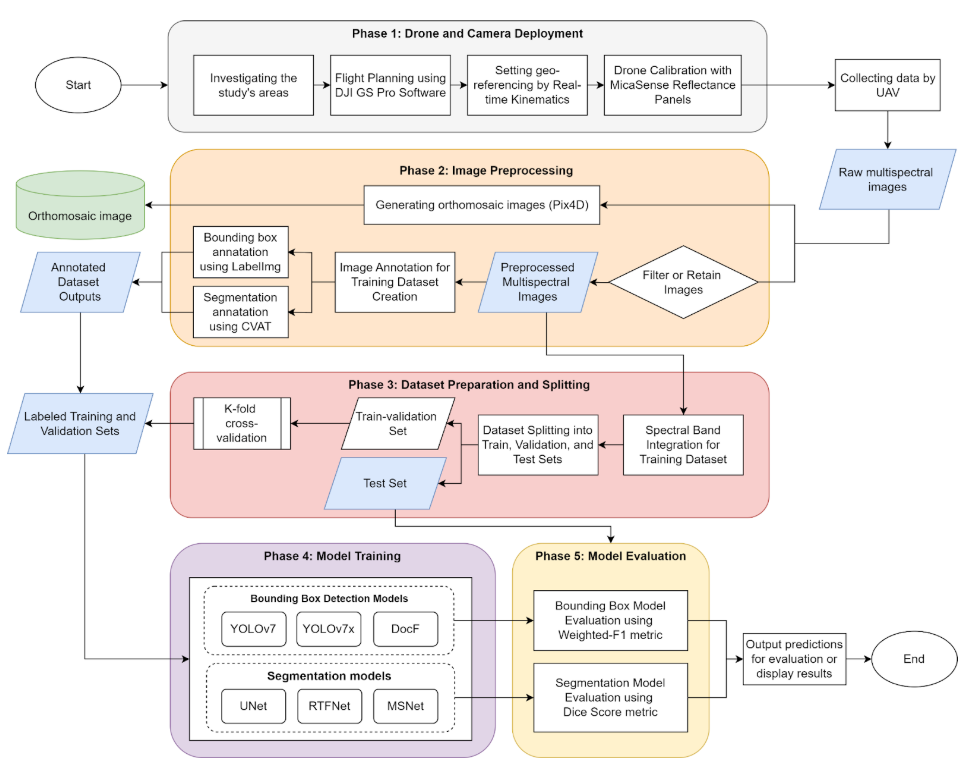
- Collect and construct the high-quality WaterMAI dataset (880 images), optimized for small and medium-sized UAV-based water body detection.
- Evaluated deep learning models UNet, MSNet, Yolov7, Yolov7x using bounding box and segmentation approaches, achieving Dice scores > 0.92
- Optimized spectral input combinations (RGB, NIR, NDWI) to enhance model accuracy for environmental monitoring.
Key technologies: UNet (segment), MSNet (segment), Yolov7 (bbox), Active Learning (for segment/bbox data labeling), multi-spectral processing
Self-driving car simulation using behaviour cloning
(Github)

- Use ROS 1 Noetic, Gazebo simulator for demo and testing the self-driving algorithm
- Autonomously drive on the designated map (highway, curves, intersection)
- Apply “Behavioral clonning”, taking input from camera and output steering angle and speed
Key technologies: ROS 1 Noetic, Gazebo, behaviour cloning
PM2.5 Concentration Prediction Using Traffic Surveillance


- Benchmarked object detection models YOLOv5, SSD, Mask-RCNN for vehicle counting to estimate PM2.5 level from specific formula.
- The final result shows 0.9 Pearson correlation between traffic density and PM2.5 levels.
Key technologies: Yolov5, SSD, Mask_RCNN, data labeling, Kalman Filter (tracking algo)
Publications
- Pham, H.V., Tran, T.G., Le, C.D., Le, A.D., Vo, H.B. (2024). Benchmarking Jetson Edge Devices with an End-to-End Video-Based Anomaly Detection System. In: Arai, K. (eds) Advances in Information and Communication. FICC 2024. Lecture Notes in Networks and Systems, vol 920. Springer, Cham. https://doi.org/10.1007/978-3-031-53963-3_25
- C. D. Le, H. V. Pham, D. A. Pham, A. D. Le and H. B. Vo, “A PM2.5 concentration prediction framework with vehicle tracking system: From cause to effect,” 2022 RIVF International Conference on Computing and Communication Technologies (RIVF), Ho Chi Minh City, Vietnam, 2022, pp. 714-719, doi: 10.1109/RIVF55975.2022.10013864.
- (UNDER REVIEW) Ngo Phuc Linh, Pham Viet Hoang, Bui Ngoc Long, Vo Bich Hien, Thirumalaisamy P. Velavan, Tran Duc Khanh. Use of low-cost drones to map arbovirus vector habitats with multispectral aerial imagery, 14 February 2025
- (ON PROGRESS) Pham Viet Hoang, Nguyen Trung Dang Khuong, Thirumalaisamy P. Velavan, Tran Duc Khanh. Neural parameters calibration for Dengue Outbreak Forecasting, 08 April 2025